-
-
Re: Great Read: A DIY Classic Car Restoration From India
I've heard of a Triumph Herald before - it was the car they shortened up to make the Spitfire. I wonder if a Standard Herald was an Indian-licensed version? -
Re: Great Read: A DIY Classic Car Restoration From India
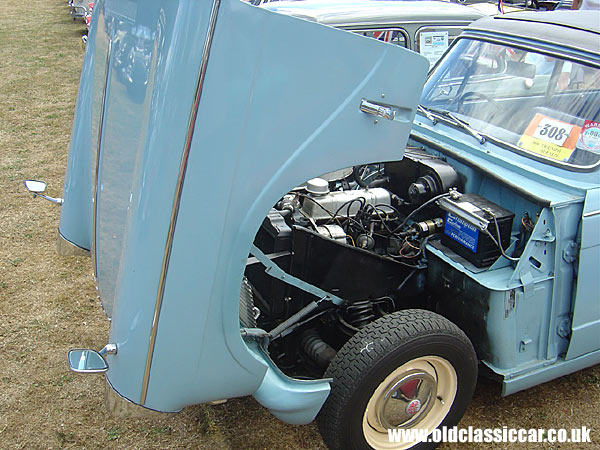
Judging by the body style I'm reasonably sure it's an Indian version of the Triumph Herald. The engine looks a lot like an Austin - they were installed in everything from Metropolitans to Sprites to gen sets.
I don't remember who on here married the Indian lady. Is there more to be learned if one surfed the web as a native speaker?
This is definitely filled with BangShiftiness! See, we're everywhere!
DanComment
-
Re: Great Read: A DIY Classic Car Restoration From India
I want to send that dude a shirt!That which you manifest is before you.Comment
-
Re: Great Read: A DIY Classic Car Restoration From India
ctx slpr
Looks like he could use a box of old used sandpaper more than he could use a shirt
My fabulous web page
"If it don't go, chrome it!" --Stroker McGurkComment
-
Re: Great Read: A DIY Classic Car Restoration From India
He'd consider sandpaper cheatin'! :DThat which you manifest is before you.Comment
-
Re: Great Read: A DIY Classic Car Restoration From India
Brian, have you ever used chem stripper,? you don't use sandpaper..Originally posted by Brian Lohnes
the brush and paint car, isn't waterComment
-
Re: Great Read: A DIY Classic Car Restoration From India
I have absolutely no clue what this means, but the guy is not using chem stripper. Read the thread, oh yeah, I did.Originally posted by IRONHEAD
Yes, of course it is being scraped, as can be seen. I do feel applying paint-remover all over the car first would be far more convenient, but didnt want to sound like I was interfering as the guy doing the work is an experienced old-timer, having worked at Auto-Chenoy (the former Standard dealer for Hyd.) at one time. So I don't wish to hurt anyone's ego or such. I would want some of the final job done to my specifications though.That which you manifest is before you.Comment
-
Re: Great Read: A DIY Classic Car Restoration From India
well, then if a picture is worth a 1000 words look for a picture of the guy siting on a chair at the pass side door with stripper and a bruch and a chisle(can on floot infront of chair at pass side door,,)Originally posted by Brian Lohnes
I saved ya the search,
so what if not brushing on stripper is he doing /or rubbing on to that panel.. surely the brush isn't chisle'n off the paint..Comment
-
Re: Great Read: A DIY Classic Car Restoration From India

Comment
-
Re: Great Read: A DIY Classic Car Restoration From India
From wiwkipedia -- great story
However, the Standard name lasted into the 1980s in India, where Standard Motor Products, Madras manufactured the Triumph Herald with the basic 948 cc engine as the Standard Herald in the 1960s, eventually with additional four-door and five-door estate models exclusively for the Indian market.
After 1970, Standard Motor Products split with British Leyland, and introduced a bodily restyled four-door saloon based on the Herald called the Standard Gazel in 1971, using the same 948 cc engine but with a live rear axle, as the Herald's 'swing-axle' one was not liked much by Indian buyers and mechanics alike. The Gazel was built in small numbers ? it has been suggested that it did so to keep its manufacturer's licence ? until 1977. With the company concentrating solely on producing commercial vehicles based on the Leyland 20, badged as Standard 20, production of Standard cars ceased until the Standard 2000, a rebadged Rover SD1, was launched in 1985. The car rode higher and had a slightly modified old 1991 cc Standard Vanguard engine, as the company could not procure the license to use the original Rover engine on this car, and was thus not successful, apart from the reasons that it faced competition from cars with Japanese and other newer, fuel-efficient technology in India. It ceased production in 1987 and was the last car to bear the Standard name.Comment
-
Re: Great Read: A DIY Classic Car Restoration From India
This restoration is so cool. No MIG welder? No problem. No sandpaper? No problem. This car is the prime example of "perfect gets in the way of done." These guys are all about fixing what they got with what they have. Any chance we can invite him to become a member?Comment
-
Re: Great Read: A DIY Classic Car Restoration From India
I remember the car as a Triumph Herald and was cool because of this.
Comment
-
Re: Great Read: A DIY Classic Car Restoration From India
This is incredible! No matter where you are in the world there are hard-working Bangshifters working with whatever they have (no matter the amount) to the max. Amen.Comment
-
Re: Great Read: A DIY Classic Car Restoration From India
makes you think , JUST how good we have it..
Comment

 Tweet
Tweet


Comment